7 Tips to Choose the Best Food Tray Sealing Machine?
Choosing the right food tray sealing machine is rarely a simple price comparison. The machine must match your tray material, product weight, sealing film, and daily production speed. A unit designed for fresh produce may not handle oily meals or hot-filled foods reliably. Small differences matter. A weak seal can leak during transport. Excessive heat can deform trays and waste film.
This guide presents seven practical tips for making a safer, more informed decision. It examines sealing temperature control, mold flexibility, gas-flushing performance, automation level, cleaning access, and after-sales support. Operators should also check changeover time. Ten unnecessary minutes between products can become hours each week. Ask suppliers for sample trials using your actual trays and products. Watch the seal after refrigeration, stacking, and gentle handling. Laboratory promises are useful, but real samples reveal more.
The best food tray sealing machine should support consistent production without creating difficult maintenance work. Check whether operators can adjust settings easily and read fault messages clearly. Confirm spare-part availability before signing an order. A low purchase price may hide expensive downtime. Still, the most advanced machine is not automatically the best choice. It may exceed your output needs or require skills your team does not have. That deserves honest reflection. Choose equipment that fits today’s operation while allowing reasonable future growth. Reliable sealing comes from the machine, suitable materials, trained operators, and disciplined quality checks working together.
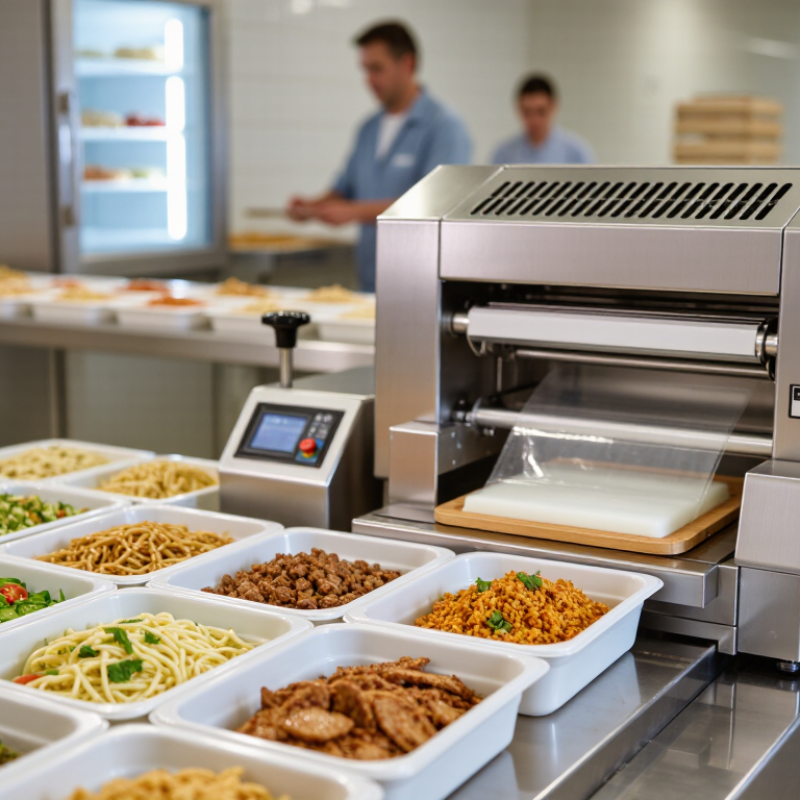
Define Your Food Tray Sealing Requirements
Before comparing machines, define the tray-sealing job in measurable terms. Record tray length, width, depth, material, product weight, and target shelf life. A chilled meal with sauce needs different sealing control from dry bakery goods. Note whether you need vacuum, modified-atmosphere packaging, or a simple heat seal. Small details matter. Film width, roll diameter, changeover time, and available floor space can affect daily output more than advertised cycle speed.
UNEP’s Food Waste Index Report 2024 estimates that 1.05 billion tonnes of food were wasted in 2022. Better sealing cannot solve every loss, but weak seals, wrinkles, and contamination can shorten product life. Set an acceptable seal-temperature range, dwell time, pressure, and leak-test method. Ask operators to test real products, including oily, wet, and uneven portions. A clean-looking seal may still fail.
Capacity should reflect your actual production pattern, not an optimistic peak. Measure trays per minute during normal shifts, then allow time for film changes, sanitation, inspection, and minor faults. PMMI industry reports repeatedly identify labor availability and flexible automation as important packaging concerns. Still, automation is not automatically better. A complex machine may reduce handling but increase training and maintenance demands. I would question any specification that ignores cleaning access, spare-part lead times, and seal verification records.
Match Machine Capacity With Your Production Volume
Tip 1 Measure your real production volume before choosing a food tray sealing machine. Record trays per minute, operating hours, product changes, and daily demand. A machine rated for 30 trays per minute may produce less during cleaning, film replacement, or tray loading. Plan for actual output, not the brochure figure.
Tip 2 Add practical capacity without creating unnecessary waste. If your line normally seals 18 trays per minute, a machine handling 22 to 25 trays may provide a useful buffer. That extra capacity can absorb busy periods and small stoppages. However, buying a much larger machine can increase costs, energy use, and operator requirements. Bigger is not always better.
Tip 3 Match the sealing format to your growth plans. Check tray sizes, sealing patterns, film width, and changeover time. In production trials, short changeovers often matter more than maximum speed. A machine that runs quickly but needs frequent manual adjustments may reduce daily output. I have seen teams focus too heavily on peak speed. It is an easy mistake. Review hourly records after installation, then compare promised capacity with measured performance. The result may reveal that staffing, loading consistency, or product temperature limits the line first.
Check Tray, Film, and Seal Compatibility
7 Tips to Choose the Best Food Tray Sealing Machine?
Tray, film, and seal compatibility should guide every purchasing decision. Grand View Research valued the global food packaging market at approximately USD 562.3 billion in 2023. That scale increases pressure for reliable, repeatable sealing. A machine may look impressive, yet still fail with your actual tray material.
Start with tray geometry. Measure flange width, corner radius, depth, and stacking tolerance. A narrow flange can produce weak seals or wrinkles. Test common materials such as polypropylene, polyethylene terephthalate, paper-based trays, and coated fiber. Film must match the tray’s sealing layer. It should also suit the product’s moisture, oxygen, and temperature requirements. Smithers’ flexible packaging research highlights continued demand for recyclable structures, but “recyclable” does not mean universally sealable.
Check seal temperature, dwell time, pressure, and peel strength together. Do not judge sealing by appearance alone. A glossy seal can still leak. Use dye testing, burst testing, and gas-leak testing when modified-atmosphere packaging is involved. ASTM sealing and leak-test methods can support consistent verification. In practical trials, test chilled trays after condensation, not only dry samples. This is where many evaluations become too optimistic.
Confirm film width, roll diameter, registration marks, and cutting tolerance. Ask for production samples before approval. Measure results across several shifts and operators. Small variations matter. A 2024 PMMI industry report identifies flexibility and changeover efficiency as major packaging priorities. Still, faster changeovers are useless if the new film needs different sealing conditions. Compatibility must be proven, not assumed.
| Tip | Compatibility Dimension | What to Check | Practical Compatibility Guidance | Common Risk if Overlooked |
|---|---|---|---|---|
| 1 | Match the Tray Material | Identify whether the tray is made from polypropylene (PP), polyethylene terephthalate (PET), crystallized PET (CPET), polystyrene (PS), paperboard with a coating, or another food-contact material. | The tray rim and the lidding film must form a compatible heat-seal pair. PP trays generally require a film sealant layer designed for PP, while PET, CPET, and coated paperboard typically require a film with a compatible sealant layer for that surface. Do not select film based only on its outer appearance. | Weak seals, delamination, leakage, or tray deformation. |
| 2 | Verify Tray Dimensions and Rim Design | Measure the tray length, width, depth, corner radius, rim width, flange flatness, and the distance between cavities when using multi-cavity tooling. | The machine format, mold, sealing plate, and cutting die must match the tray footprint. A continuous, clean, and sufficiently wide flange is needed for a reliable seal. The tray should sit flat without rocking or contacting the sealing plate outside the intended area. | Incomplete seals, film wrinkles, poor cutting, and damaged tooling. |
| 3 | Select the Correct Lidding Film Structure | Check the film's sealant layer, thickness, stiffness, transparency, barrier properties, print side, and whether it is peelable or permanent-seal. | The sealant layer must be designed for the tray rim material and the intended sealing process. Peelable films are useful when easy opening is required; permanent-seal films are selected when stronger closure and tamper resistance are priorities. Oxygen or moisture barrier film may be needed for products sensitive to oxidation or humidity. | Film may not seal, may be too difficult to open, or may provide inadequate shelf-life protection. |
| 4 | Confirm Sealing Temperature and Dwell Range | Review the film supplier's recommended sealing temperature, pressure, and dwell time, then compare them with the machine's adjustable operating range. | Use the film supplier's technical data as the starting point because sealing temperatures vary by sealant chemistry, film construction, tray material, and equipment. The machine should provide stable temperature control and sufficient dwell time for the required production speed. Validate settings with seal-strength and leak tests. | Under-sealing can cause leaks; over-sealing can distort the tray or make peelable film difficult to open. |
| 5 | Check Product and Atmosphere Requirements | Determine whether the product requires standard sealing, vacuum skin packaging, modified atmosphere packaging (MAP), or a leak-resistant seal for liquids and sauces. | Standard tray sealing may be sufficient for dry or short-life products. MAP requires gas flushing, controlled evacuation or gas replacement, compatible high-barrier materials, and a seal that limits gas leakage. Products with liquid, sauce, or contamination on the rim require equipment and process controls suited to that condition. | Shortened shelf life, package swelling or collapse, leakage, and food-safety concerns. |
| 6 | Match Output, Automation, and Tooling | Compare required trays per minute, number of lanes, manual or automatic loading, roll-film or pre-cut-lid operation, changeover frequency, and available utilities. | Choose a machine whose rated output is suitable for the actual tray format and sealing cycle, not only its maximum advertised speed. Confirm compatibility with the required mold sets, film width, film roll diameter, compressed air, electrical supply, and upstream or downstream equipment. | Production bottlenecks, excessive downtime, unstable sealing, or costly modifications. |
| 7 | Run a Compatibility Trial Before Purchase | Test the actual tray, film, product, filling level, and intended packaging atmosphere using the proposed machine or equivalent tooling. | Evaluate seal integrity, peel force, leak resistance, seal appearance, film tracking, cutting accuracy, tray deformation, package dimensions, and performance after storage. For food applications, also confirm that materials comply with the food-contact regulations applicable to the target market. | A machine may appear compatible in theory but fail under real production conditions. |
Compare Automation, Speed, and Sealing Performance
7 Tips to Choose the Best Food Tray Sealing Machine
Compare Automation, Speed, and Sealing Performance
Tip 1: Match automation to your daily workload. A manual unit may suit small batches, while automatic loading reduces labor during long shifts. Tip 2: Check usable speed, not only the advertised cycle rate. Observe output with real trays, film changes, and short pauses. Fast on paper. Slower in practice. Tip 3: Inspect feeding accuracy. Trays should enter squarely, without tilted edges or crushed corners. A simple guide rail can prevent repeated stoppages.
Tip 4: Test sealing performance with your actual food containers. Film tension, tray material, temperature, and product moisture all affect the seal. Ask for samples from your production line. Tip 5: Look for stable temperature control. Uneven heat can create weak corners, wrinkles, or overheated film. Record seal results across several hours, not just one successful trial. Tip 6: Consider changeover time. Operators should adjust sizes without complicated tools or unclear instructions. Five extra minutes, repeated fifty times, becomes lost production.
Tip 7: Verify inspection and maintenance access. Clear sealing plates, sensors, and removable parts support safer, more reliable operation. Experienced operators often notice details that brochures miss. Listen to them. I would also question machines promising maximum speed with every tray size. That claim may sound attractive, but real performance depends on staffing, packaging materials, cleaning routines, and product variation. Ask for documented test data, training details, spare-part availability, and practical support before making the final choice.
Evaluate Safety, Maintenance, and Total Operating Cost
Choosing the best food tray sealing machine requires more than checking sealing speed. Safety, maintenance, and total operating cost often decide long-term performance. The 2022 FDA Food Code emphasizes cleanable equipment, contamination control, and proper maintenance. Choose stainless-steel surfaces, tool-free access, guarded heating areas, and visible emergency stops. Ask for documented risk assessments and operator training records.
Tip 1: Test the machine with your actual trays, films, sauces, and product temperatures. A seal that looks perfect may fail after refrigeration. Measure leak rates, film waste, changeover time, and energy use. The U.S. Department of Energy reports that compressed-air systems can represent significant industrial energy use, especially when leaks remain unnoticed. Check pneumatic leakage during acceptance testing. Small leaks become expensive.
Tip 2: Build a three-year cost model. Include electricity, compressed air, film, rejected trays, cleaning labor, spare parts, service visits, and downtime. PMMI’s 2024 packaging industry reporting highlights labor pressure and automation as continuing investment drivers. Automation can reduce repetitive work, but it also adds sensors and controls that require skilled maintenance. That part is easy to underestimate. Tip 3: Request preventive-maintenance intervals, spare-part prices, and remote-support limits in writing. Track seal temperature, pressure, dwell time, and unplanned stops weekly. I would not rely only on the supplier’s advertised output; real products are messier, and production teams rarely run perfect cycles.
7 Tips to Choose the Best Food Tray Sealing Machine
Evaluate safety, maintenance, sealing performance, and total operating cost before making a purchasing decision.
This practical evaluation model assigns a 100-point priority score across seven common purchasing criteria. Safety, seal consistency, maintenance access, energy efficiency, changeover time, operator usability, and total operating cost should be reviewed together. Always verify actual performance with supplier documentation and production-line trials.
Related Posts
-
What is the Impact of Tray Sealing Machines on Food Packaging Efficiency
-
How to Choose a Tray Sealing Machine for Your Business
-
How to Choose a Tray Sealing Machine in 2026?
-
How to Choose the Best Tray Sealing Machine for Your Packaging Needs
-
Understanding the Problems with Selecting the Best Tray Sealing Machine for Your Production Needs
-
Why Choose a Tray Sealing Machine for Your Packaging Needs?